Jisoo, Paris Fashion Week Black Dress
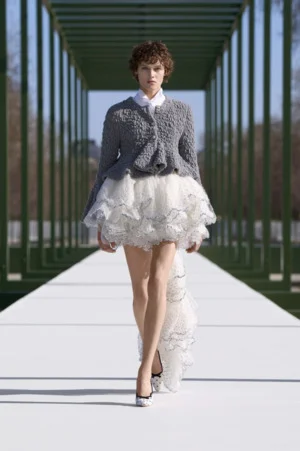
The Dior 2026 F/W Collection was unveiled, transforming the everyday act of "strolling" into a fashion language at the pond in the Tuileries Garden in Paris. Creative Director Jonathan Anderson set "seeing and being seen" as the core theme, drawing inspiration from the "strolling culture" of the Tuileries Garden, which opened to the public in 1667. He emphasized that fashion can be a performance that interacts with the gaze of others, injecting modern vitality into Dior.
Through the French cultural concepts of promenade (a stroll in the park, dressed up, observing each other) and flâneur (a person who wanders leisurely through the city, observing people and scenery), Anderson visually interpreted how people in the city look at each other and reveal themselves on the runway. The show took place on an octagonal in-the-round runway installed around the Tuileries Garden pond, allowing the audience to see the models' movements and silhouettes from 360 degrees. The runway followed the outer edge of the pond, and the seating and structures were designed with reference to the iconic green chairs of Parisian parks, creating a scene of chance encounters and exchanged glances in the park.
광고 영역
The show's invitation was sent out as a miniature green wrought-iron chair, a symbol of Parisian parks, representing an attempt to extend Parisian everyday aesthetics into a collectible design object. From the entrance of the venue, the audience experienced the feeling of being a "Flâneur" in historic Paris. The stage production also reinforced the concept: a glass greenhouse structure and artificial lotus flowers installed in the center of the octagonal fountain evoked Claude Monet's "Water Lilies," blurring the boundaries between nature and artifice, reality and image.
※ 이 포스팅은 쿠팡 파트너스 활동의 일환으로 수수료를 제공받습니다.
Anderson focused on points where water reflects light like a mirror, metaphorically expressing the gap between people's true selves and their socially constructed images when they look at each other in the city as "visual illusions and social images." This connects with the concept of the flâneur in Charles Baudelaire's Les Fleurs du Mal, expanding the fashion show into an urban scene. Furthermore, he translated the tension between individual identity and social gaze, explored in Radclyffe Hall's novel The Well of Loneliness, into fashion, showing that a seemingly romantic stroll is also a social space for observing and evaluating others.
The collection's designs reinterpreted Dior's iconic Bar Jacket tailoring with Donegal tweed and relaxed proportions, combining it with structures influenced by 18th–19th century attire to modernize classic couture silhouettes. Historical details such as frock coat-style jackets, peplums, bustle skirts, and tiered tulle created structural tension. Floral motifs went beyond simple prints, manifesting as pattern cutting, voluminous silhouettes, and appliqué embellishments, evolving into asymmetrical draped skirts that flowed like petals, structured dresses reminiscent of flower buds, and lotus motif shoe designs. Anderson sought to elevate "the making of things," treating everyday materials like denim with couture techniques such as embroidered denim.